
Simulated World Training: 9 Failure Modes Only Real Data Fixes

A simulated world lets you train a robot policy on millions of rollouts without breaking a single motor. But every simulator makes physics compromises, and your model inherits each one as a blind spot. These nine failure modes explain why policies ace simulation benchmarks and then stall on real floors, and what real data must cover first.
The nine failure modes at a glance
- Contact physics drift
- Deformable object blindness
- The rendered sensor gap
- Asset library ceilings
- Missing environments
- Scripted human behavior
- Actuator and latency mismatch
- The scale illusion
- Eval contamination
1. Contact physics drift
Simulators reduce friction and contact to clean equations, and real surfaces refuse to cooperate.
Physics engines like MuJoCo and Isaac Sim resolve contact with rigid body solvers and a single friction coefficient per surface. Real friction shifts with humidity, dust, wear, and temperature. OpenAI’s robotic hand consumed roughly 13,000 years of simulated practice plus aggressive domain randomization to manipulate a Rubik’s cube, and it still completed only 20 percent of the hardest scrambles on physical hardware. The bottleneck was not compute. It was contact. Grasping, insertion, and in hand robot manipulation all live or die on forces the simulator can only approximate.
Why it matters: if your deployment task involves touch, your eval lift in sim tells you almost nothing about deployment success.
2. Deformable object blindness
Most simulated environments model rigid bodies, and most useful work involves things that bend.
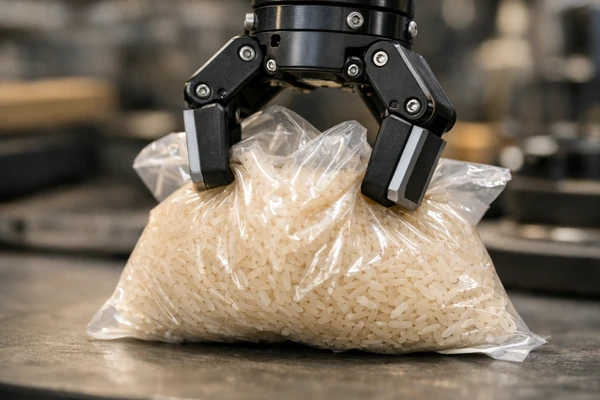
Cloth, cables, food, paper, packaging, biological tissue. Deformables break the core assumptions rigid body solvers rely on, which is why simulation research overwhelmingly benchmarks on blocks, pegs, and mugs. A warehouse is full of poly bags that crumple. A kitchen is full of dough. A hospital is full of tubing and fabric. Policies pretrained on rigid assets drop sharply the moment an object deforms in the gripper, because the visual and force feedback has no precedent in training. Real demonstrations of humans handling soft objects remain the only reliable source of that signal.
Why it matters: list your deployment objects and count how many deform. That number is your sim blind spot.
3. The rendered sensor gap
A rendered frame is not a camera frame, and your model can tell the difference.
Real cameras add rolling shutter, motion blur, lens flare, sensor noise, and auto exposure that hunts when lighting changes. Renderers produce clean pixels. Waymo built its world model on top of Genie 3 specifically to output synchronized camera and lidar streams, because sensor level realism decides how much of the sim to real gap your simulated miles actually close. Lidar returns in rain, glare at sunset, a smudged lens. None of it exists in a default render pipeline. Vision policies trained on clean frames latch onto texture and lighting cues that vanish on hardware.
Why it matters: your perception stack fails at the sensor, not the policy. Test against real captures early.
4. Asset library ceilings
Every simulated world draws from a finite asset catalog, and models memorize the catalog.
Popular sim setups reuse the same few thousand object meshes and scene templates. Generative world models raise the ceiling but introduce new defects. World Labs notes that AI generated geometry can look correct while hiding self intersections and wrong scale that produce nonsense physics. Genie 3 renders interactive worlds at 24 frames per second, which is remarkable, and still cannot guarantee the mass or friction of a single object in the scene. The real world supplies unlimited object variation with correct physics attached for free.
Why it matters: if your policy has seen every training object 400 times, your generalization score is measuring memory.
5. Missing environments
A simulated world renders the environments its builders live in, and most of the planet is not on the asset store.
Unpaved roads. Mixed traffic with two wheelers and handcarts. Dense street markets, monsoon lighting, small kitchens with open flames. Western built simulators barely render any of it, so a navigation policy trained on tidy suburban scenes meets a dense Global South city with zero exposure. This is the quiet reason global deployments of embodied AI underperform their benchmark numbers. The internet scale data era handed language models the whole world’s text. Physical AI gets no such gift. Someone has to capture those environments on real sensors, in the field, at deployment fidelity.
Why it matters: check your target markets against your sim scenes. The mismatch is your churn forecast.
6. Scripted human behavior
Simulated people follow scripts, and real people do not.
Pedestrian agents in sim obey crossing logic and speed curves. Real pedestrians hesitate, jaywalk, carry loads that change their gait, and check their phones mid crossing. Waymo’s system can simulate unusual pedestrian behavior and even tornadoes, but only because a decade of logged real driving seeds the distribution. Human hand motion is harder still. Grasp strategies, regrips, bimanual coordination. No behavior tree covers it, which is why robot learning from human demonstration through egocentric video is currently the only scalable source of human motion priors.
Why it matters: any system operating near people inherits risk directly from how honestly its training data models them.
7. Actuator and latency mismatch
Sim applies torque instantly and perfectly, and your hardware does neither.
Real actuators carry backlash, gear wear, thermal throttling, and control loops with jitter measured in milliseconds. A policy tuned to ideal torque response oscillates on a physical arm. Legged robotics labs learned this early. Reliable transfer for quadrupeds required modeling actuator dynamics with networks trained on real motor data, not spec sheets. The lesson generalizes. A simulator is only as honest as the system identification behind it, and system identification requires measurements from your actual hardware under load.
Why it matters: budget for hardware in the loop data collection before the training run, not after the first oscillation.
8. The scale illusion
A million rollouts from one distribution is one data point, repeated.
Simulation’s pitch is scale. Millions of episodes overnight at near zero marginal cost. But the episodes vary only along the axes you randomized, and domain randomization ranges are human guesses. This is why the field’s flagship real robot training data effort exists at all. Open X-Embodiment pooled over one million real robot trajectories across 22 embodiments from 21 institutions, because the labs involved concluded that real diversity cannot be synthesized from parameters. Scale that stays inside one engine’s physics is width without depth.
Why it matters: ask vendors how many distinct real environments back their numbers, not how many episodes.
9. Eval contamination
Evaluate in the simulator you trained in and the model grades itself with its own answer key.
Every physics bug, rendering shortcut, and asset quirk in the training engine appears identically in the eval. Scores inflate. Teams report 95 percent task success in sim, see 40 percent on hardware, and call it a transfer problem. It is a measurement problem. The eval never measured deployment. The fix is boring and non negotiable. Hold out a real world eval set, captured on real sensors in deployment matched environments, and treat sim scores as a training signal, never as an acceptance gate.
Why it matters: your board sees the eval number. Make sure it predicts revenue, not renderer agreement.
Simulated world data versus real world data
| Dimension | Simulated world data | Real world data |
| Marginal cost per episode | Near zero after setup | Dollars per episode |
| Physics fidelity | Approximated, engine specific | Ground truth by definition |
| Labels | Perfect and free | Requires annotation and QC |
| Object and scene diversity | Capped by the asset catalog | Effectively unlimited |
| Sensor realism | Rendered and idealized | Native |
| Eval trustworthiness | Inflated by shared engine bugs | Deployment predictive |
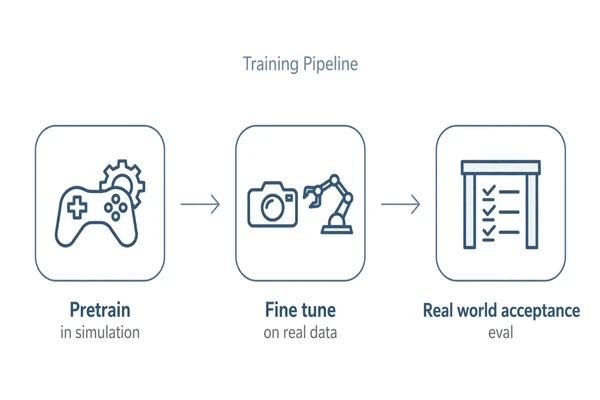
| Best role | Pretraining and rare event practice | Fine tuning and acceptance evals |
The strongest pipelines run both. Synthetic training data for cheap breadth, then real data for the physics, sensors, and environments the engine cannot honestly claim. Our guide to training data for robotics covers how to sequence the two.
Where the real data comes from
Humyn Labs supplies the real world half of the pipeline. The verified contributor network captures egocentric video and teleoperation demonstrations in homes, streets, and workplaces across Global South and other regions most simulators never render, then runs them through validation, multilayer QC, and annotation before delivery. Every batch passes multilayer QC before delivery, and low scoring capture gets discarded rather than shipped. If a simulated world trained your model, real data has to certify it. Talk to us about building your deployment matched eval and fine tuning sets.
FAQ
What is a simulated world in AI training?
A simulated world is a software environment, built with a physics engine or a generative world model, where AI agents practice tasks safely and cheaply. It supplies unlimited episodes with perfect labels, at the cost of approximated physics and a hard ceiling on diversity.
Can you train a robot entirely in simulation?
No. Policies trained only in sim consistently underperform on hardware because contact physics, sensor noise, and actuator dynamics differ from the engine’s approximations. Standard practice is pretraining in simulation, then fine tuning and evaluating on real world data captured from physical sensors.
Why do robots trained in simulation fail in the real world?
They overfit to the simulator’s specific approximations. Friction values, rendered lighting, scripted humans, and instant torque all differ from reality, so the learned policy keys on cues that vanish on hardware. Researchers call this the sim to real gap, and it shows up on day one.
How much real data do you need to close the sim to real gap?
It depends on the task, but fine tuning typically needs hundreds to thousands of real demonstrations per task family, plus a held out real eval set. Contact heavy tasks like insertion and deformable handling sit at the expensive end of that range.
Is synthetic data cheaper than real data?
Per episode, yes, by orders of magnitude once the environment is built. Per unit of deployment performance, often no. Teams that skip real data pay later through failed deployments, extended debugging, and retraining. Price both against deployment success, not episode count.
How do world models relate to simulated worlds?
A world model learns to predict how an environment changes in response to actions, and can generate a simulated environment as its output. Genie 3 and the Waymo World Model are current examples. Both still depend on real sensor data as training input.
Fund the run with your eyes open
A simulated world buys you speed. Real data buys you truth. Fund the training run only after you know which of these nine failure modes your pipeline covers, and send Humyn Labs the list you cannot cover alone.


